literacy
6 July 2026
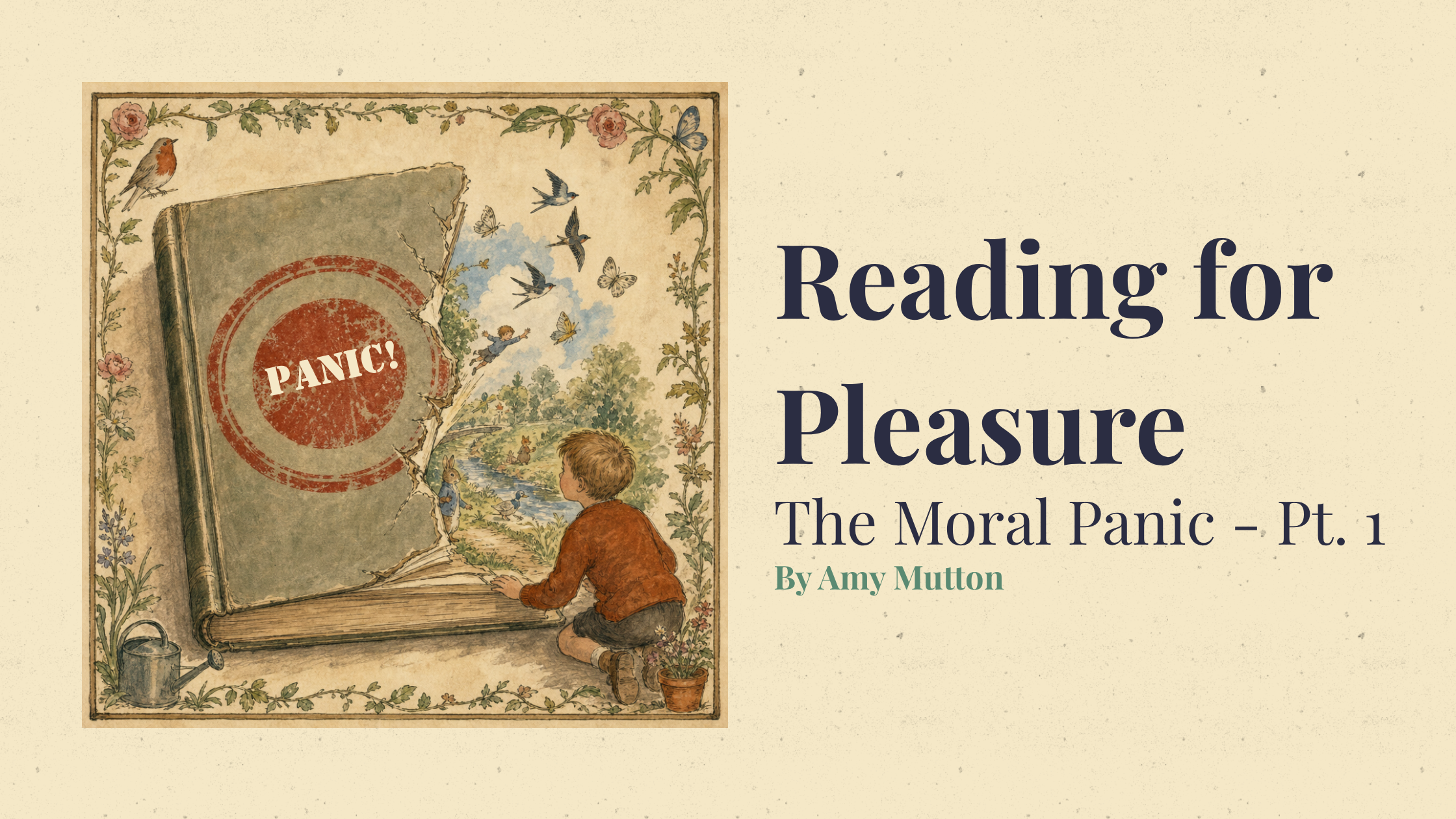
We are in the middle of a national effort to get children reading for pleasure. The National Year of Reading 2026 is under way. Survey after survey shows enjoyment at or near twenty-year lows. Only about one in three children aged eight to eighteen say they enjoy reading in their free time. Daily reading is even rarer. The numbers for primary-aged children and for boys have fallen especially sharply.
The response, understandably, has been to treat this as an emergency. More pressure. More logs. More schemes designed to make children read. The language around it often carries the tone of a public-health campaign. We must get them reading for pleasure, or else.
The trouble is that the phrase “reading for pleasure” has come to stand for two quite different things at once, and the panic keeps them glued together.
There is the skill of reading: decoding, fluency, comprehension. This can be measured, tested, and taught with targets. Then there is the hobby of reading: choosing a book because you want to know what happens next, staying up too late because the story will not let you go, carrying a book everywhere because the world inside it feels more alive than the one outside. The value of the hobby is not the act of reading itself. The value is what the stories do to you. They expand what you can imagine. They let you see the world through someone else’s eyes for a while. They give you new ways of thinking about yourself and other people. That is the payoff. Everything else is infrastructure.
We do not treat other skills this way. We do not run national campaigns to get children woodworking for pleasure by forcing them to measure and cut pieces of wood they did not choose, for projects they do not care about, with success measured in how neatly they followed the instructions. The skill of measuring and cutting matters. The hobby of woodworking matters more because its value is fixing something broken in the house or making something that will last. The same is true of knitting. The skill is real. The hobby produces warm socks that fit. The value is both the making and the using.
When we collapse the skill and the hobby into one urgent project called “reading for pleasure,” we end up doing strange things. We take children who are already struggling with the skill and hand them books that have been engineered to be “accessible.” The books are often thin on story and thick on controlled vocabulary. The child works hard, sometimes through tears, to reach the end. The payoff is frequently a weak joke or a tidy moral that lands with a thud. The effort-to-reward ratio is terrible. After enough of those experiences, the child does not conclude that reading is pleasurable. They conclude that books are worksheets with pictures.
This pattern became more pronounced after the curriculum reforms of the 2010s. The 2014 national curriculum narrowed focus in ways that emphasised measurable outcomes. The push for validated systematic synthetic phonics programmes intensified, with many schools moving to highly structured schemes in the years around 2019–2021 which was a period already disrupted by Covid closures, bubbles, and enormous pressure on teachers. Families who had seen high engagement with multi-sensory and varied approaches often experienced a sharp drop when the new programmes prioritised rigid fidelity over the broader, more contextual elements that had worked better for some children. Many dyslexic learners and others who needed richer multi-sensory input were particularly affected. Schools still read richer literature aloud, which is valuable, but almost every other contact with books became skills-building rather than story-living.
The panic is real. The diagnosis is mostly wrong. Treating declining pleasure as a motivation problem to be solved with more pressure misses the actual books children are being asked to read and the deeper question of whether those stories respect their intelligence and give them agency. That is where the next part of this series goes.